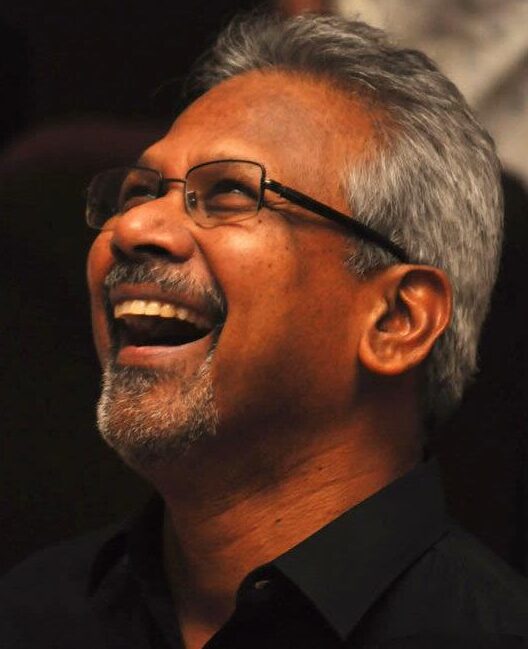
“There are two things that bother a filmmaker. One, when he is ordered a lifetime achievement award. The second is when he is asked to do a book on his films. Both invariably mean that the sell-by date is round the corner, or worse, that it has passed.”
— Mani Ratnam, A Note, in Conversations with Mani Ratnam by Baradwaj Rangan (Penguin Books, 2012), p. x.
Mani Ratnam, born on June 2, 1956, has reshaped Indian cinema through groundbreaking films like Nayakan and Anjali both selected as India’s official entries to the Academy Awards. Nayakan was also featured in Time magazine’s list of the “All-Time 100 Best Films.” A Padma Shri awardee, Mani Ratnam began his filmmaking journey with Pallavi Anu Pallavi (1983), which won the Karnataka State Award for Best Screenplay.
He was next offered Unaroo, which unfortunately didn’t succeed at the box office. However, Pagal Nilavu and Idaya Kovil, both released in the same year, marked his steady rise Idaya Kovil being a commercial success. It was Mouna Ragam that truly established him as a major director, earning him a National Film Award and his first Filmfare Award.
In 1987, he directed the legendary Nayakan, starring Kamal Haasan widely regarded as one of the greatest gangster films ever made. Following its acclaim, he directed several commercially and critically successful films such as Agni Natchathiram, Thalapathi, OK Kanmani, Ponniyin Selvan, and many more.
His film Iruvar became a cult classic and was internationally acclaimed, along with Dil Se, which, like Roja and Bombay, formed a trilogy that addressed national issues through deeply human characters. These films were screened at international film festivals and expanded Mani Ratnam’s global reach.
Among his emotionally resonant films, Kannathil Muthamittal stands out a poignant narrative about a girl, Amudha, who learns of her adoption and searches for her birth mother amidst a war-torn landscape. His ability to portray love whether lost or found is unparalleled, often depicted in the simplest yet most lyrical ways: through bus rides, train stations, rain, and silences. His romantic narratives are cinematic poetry.
One of the most anticipated releases is Thug Life, his upcoming collaboration with Kamal Haasan their first since Nayakan.
Mani Ratnam has cited Balu Mahendra and Akira Kurosawa as major inspirations. Balu Mahendra, in fact, was the cinematographer of Pallavi Anu Pallavi. Ratnam has consistently worked with brilliant technicians such as Thotta Tharani and Ilaiyaraaja. His collaboration with Ilaiyaraaja lasted until Thalapathi, after which A.R. Rahman became his primary composer a partnership that has produced some of Indian cinema’s most iconic soundtracks.
He has also worked closely with cinematographers like P.C. Sreeram and Santosh Sivan. As Santosh Sivan once said, “Any cameraman can hone his skills just by working with Mani.” Their collaborations include Roja, Thalapathi, Dil Se, and Raavan, each offering a unique visual identity. A notable scene in Thalapathi, where Surya watches Subbulaxmi walk away at sunset, exemplifies the perfect blend of cinematography and emotion.
P.C. Sreeram, Rajiv Menon, and Ravi Varman have also contributed significantly to the distinctive visual grammar of his films. Ratnam’s use of symbolism often subtle and deeply layered makes his films rewarding upon multiple viewings.
His storytelling often addresses social, political, and regional issues with nuance, bringing unexplored realities to mainstream cinema. His adaptations of epics Raavan (from Ramayana) and Thalapathi (from Mahabharata) stand out as rare successful reinterpretations of Indian mythology in cinema.
Despite his legendary status, Mani Ratnam remains his own harshest critic. He is known to revisit his films and point out mistakes an admirable quality that reflects his continuous evolution as an artist and a mentor to generations of filmmakers.
Mani Ratnam is not just a filmmaker he is a storyteller, an innovator, and a visionary who continues to redefine the boundaries of Indian cinema.